Disconnected Scheduling Are Costing Healthcare Organizations Patients — Keona Health Shows How to Fix the Gaps
Chapel Hill, United States – March 16, 2026 / Keona Health /
CHAPEL HILL, N.C. – Keona Health has released a practical diagnostic framework for patient access directors, call center managers, and healthcare operations leaders who want to identify whether fragmented systems are driving missed appointments and poor call center performance in their organizations.
The framework includes a structured scorecard and a checklist of the most common fragmentation points, along with diagnostic questions leaders can use to evaluate their current architecture. Among the warning signs it surfaces:
-
Patients are repeating information across channels because there is no shared record that connects them
-
Agents re-entering the same data into multiple systems on a single call
-
After-hours requests that fail to carry over into the next day’s schedule
The analysis finds that fragmented patient access infrastructure is a leading driver of these problems, even at organizations that have already invested in engagement tools like reminders, chatbots, and digital scheduling.
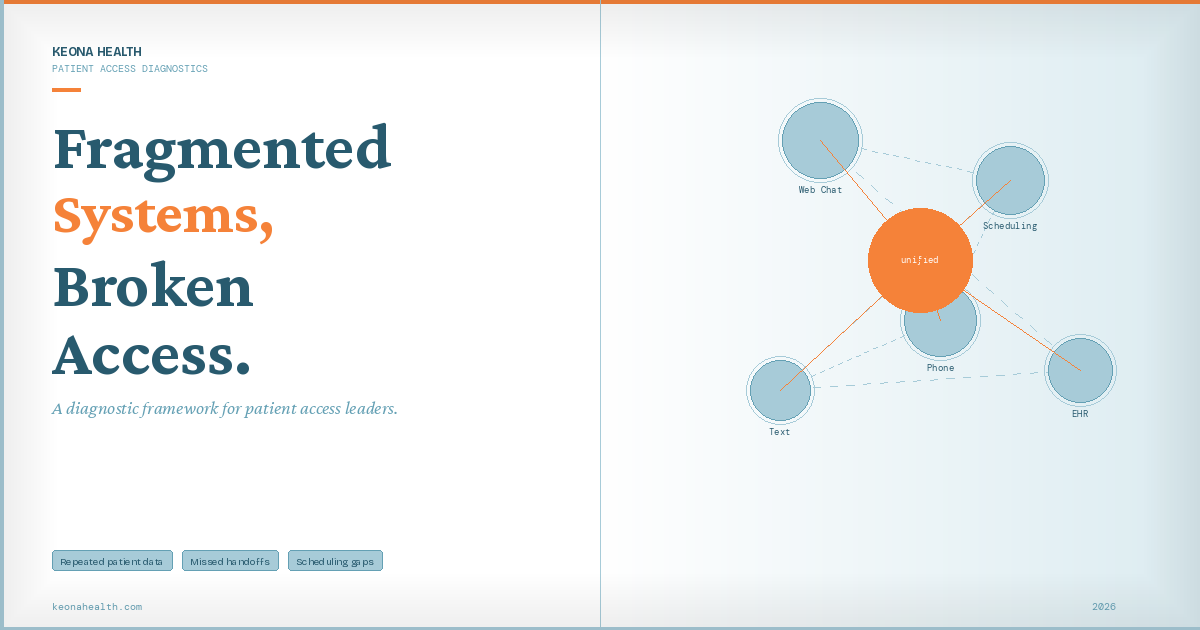
“The reason is architectural,” said Stephen Dean, COO of Keona Health. “When web chat logs in one platform, phone calls live in another, and scheduling exists in a third, the patient context is lost at every handoff.”
Most healthcare organizations have invested heavily in point solutions. The problem is that sophisticated individual tools do not add up to a coherent patient access experience when they operate in silos. Staff ask questions that patients have already answered. Calls escalate unnecessarily. The patient moves from system to system without anyone holding the full picture.
What a Unified Patient Access Architecture Can Improve
The framework introduces what Keona Health calls a unified system of record for patient access: one shared timeline of every patient interaction across phone, web, text, and scheduling. This is what the company refers to as a unified system-of-record architecture.
Healthcare networks that make this shift report that patient history, insurance status, scheduling constraints, and clinical protocols transfer automatically across every channel transition. Keona Health reports that organizations using CareDesk’s unified patient access architecture saw measurable improvements in no-show rates, first-call resolution, and average handle time within 90 days of adoption.
The same principle applies to AI. AI that is not connected to scheduling rules and patient history can create the same handoff gaps as any other disconnected tool.
“AI operating within a unified Healthcare CRM architecture enables seamless handoffs between automated and human assistance, with complete patient context intact at every step,” Dean said. “You can have the best single-point solution, but that’s not going to impress the patient who has to jump from person to person or system to system to get their issue resolved.”

Keona Health’s CareDesk platform serves as a unified system of record for patient access across voice, web, chat, and text channels, maintaining a complete interaction history from initial inquiry through completion of the appointment.
Read more about the diagnostic framework at keonahealth.com.
About Keona Health
Keona Health provides AI-powered patient communication and scheduling solutions for healthcare organizations. The company’s CareDesk platform integrates patient assistance capabilities designed to support healthcare call center operations and administrative workflows. Keona Health is based in Chapel Hill, North Carolina, and serves healthcare providers across multiple specialties.
Contact Information:
Keona Health
510 Meadowmont Village Circle Suite 250
Chapel Hill, NC 27517
United States
Ryan Hunt
(919) 246-8520
https://www.keonahealth.com